Fibromyalgia, Travel & Creative Nonfiction | Sometimes You Have to Be Poked & Prodded (Boston Update)

It’s been a long day. Actually. it’s been a long weekend. I arrived in Boston on Saturday night but didn’t arrive at my hotel until early Sunday morning. Slept for 3 hours, contemplated why the universe placed a homemade ice-cream place next to where I’m staying. Bought myself some grapenut ice-cream, slept 3 more hours, woke again, and contemplated some more. Slept 3 more hours. Rushed to catch a bus, and then another. Went to the dentist. Endured 3 novocaine shots. Replaced two fillings. Walked way more than I should have. Felt accomplished. Went to the dermatologist. I don’t have anything cancerous. But my hair is thinning due to PCOS…probably.

Took my time to catch a bus, to catch a subway, to wait for another bus, to take that to my final appointment. Saw my doctor. She made me laugh. Actually, we make each other laugh. I’ve gained too much weight. That may have affected my mood. I need to be on more medications.  That may help my mood. It may help my thinning hair. It may help my weight. I smile and laugh. I get sent down to the lab to pee, to give 4 vials of blood, to get hit on by a random hospital worker.

I remind myself that I still need to pack things, to bring my life into some kind of order. I’m asked what I am doing in Rome. I say I am living. I ask myself that, too. I respond the same way. I poke and I prod myself. I take deep breaths like I’m told to, like I tell myself. My blood pressure isn’t so high. Still I need to get back on my medications. I need to control myself. I need to prod myself. To poke myself into some kind of action.

I speak about overcoming depression, fibromyalgia, being in my late thirties…because 37 is late, it’s not mid anymore. My body is changing. It needs different things than what I’m used to giving it.

It’s 18:11. I need to get home…but where is it?

Fibromyalgia & Alternative Treatments | Tai Chi Anyone? If Not, Let’s Take a Walk!

Image from FibromyalgiaNewsToday.com. Found on FlipBoard.com.  Click to read the article "Tai Chi Practice Has an Anti-Aging Effect and Can Help Fibromyalgia Patients Cope with the Disease"

Image from FibromyalgiaNewsToday.com. Found on FlipBoard.com. Click to read the article “Tai Chi Practice Has an Anti-Aging Effect and Can Help Fibromyalgia Patients Cope with the Disease”

My mother has a massive collection of old VHS tapes, some going back to the early 1980s.  In the mix of these, I happened upon a major gem; T’ai Chi for Health: Yang Short Form with Terry Dunn (DVD available on Amazon).  One of the most important factors, I think, in improving self-management of fibromyalgia is always keeping your mind open and exploring as many means as possible to take care of your body, means that go beyond stuffing one’s body with medications.

Trust me, it’s easy to get into the habit of having to take several medications just to function.  Although there is nothing wrong with that, I believe that there must be other ways to live, i.e. rather than having to take medications to get up, to sleep, to manage pain, to focus, etc.

When I first became ill in 2005/6, for the first two years, I was living that life: consuming upwards of 10 pills just to cope.  Perhaps it was necessary then.  However, I decided to decrease the number of medications I had to take just to live.  Now, I only take 2, one specifically for my FMS and the other for my blood pressure.

Also, one of my internal struggles was dealing with what I considered a massive betrayal of my body.  Prior to graduate studies, I worked at a fitness center, teaching classes and doing personal training.  My body was strong, and I prided myself on its strength. Suddenly…that was gone. I couldn’t do any of the things that I once could.  Moreover, I felt an overwhelming sense of self-resentment because of this change. As a result, I stopped trying to lift weights, do yoga, dancing, etc. I gave up on living an active life.

I had to break my “ego” down to accept and enjoy what I could still do: walk. That was in 2009.

Fast forward to today and I’m still walking. I’ve made a commitment to walking each day…even if it is a few steps. I still get out of my bed and walk. Normally, I do not give myself a time limit. I listen to my body and I listen to music. I give myself a song limit on my better days–no more than 11 songs.  That’s my aim: keep moving one foot in front of the other for 11 songs.  

Still, I am always on the lookout for new ways to improve.  This is where the aforementioned tai chi video comes in.  Just recently, I decided to try my hand at this video, and I really enjoyed it.

More importantly, after doing a little digging, I learned that research has been done on the benefits of tai chi for people with fibromyalgia: read about a study in the New England Journal of Medicine, “Randomized Trial of Tai Chi for Fibromyalgia” and check out Flipboard’s posts on tai chi, including this one “Fibromyalgia Tai-Chi Treatment: Is It Effective Or Not?” by FibromyalgiaTreating.com.

I’ve only started, but can state that I found it interesting. I think, however, that I would prefer doing tai chi in the company of others than just with this video.  Still, I’ll take what I can get! Perhaps when I get back to Rome, I will find a place where others are practicing. For now, I’ll be practicing in my home, and I’ll let you know how it all goes!

Until Next Time,

D.

Fibromyalgia & Work | Understand Your Limitations, Exceed Your Expectations

Image from MadameNoire.com. Click to read their article, "The 'Itis: Foods that are making you sleepy at work"

Image from MadameNoire.com. Click to read their article, “The ‘Itis: Foods that are making you sleepy at work”

This is hardly breaking news, but having fibromyalgia sucks. Indeed, along with other chronic illnesses, fibromyalgia is quite adept at throwing a monkey wrench into even the best laid plans. In my opinion, this is due to the unpredictability of the onset of symptoms and the negative psychological impact that that unpredictability promotes. If you have fibromyalgia, it may seem downright hard to plan for the moment, much less the next day!  So, what does that mean for those of us who are working or looking for work?

What I’ve come to understand through personal experience is that the people surrounding me can fall into one of six categories: 1) the knowledgeable and supportive, 2) the knowledgeable and enabling, 3) the knowledgeable and uncaring, 4) the ignorant and dismayed, 5), the ignorant and dismissive, 6) the ignorant and plaintive. Sometimes people may bounce between categories.

What does any of this have to do with work, much less the title of this post? Simple: if you have fibromyalgia and are still working or looking for work, you must be prepared to encounter these people.  You  must understand how what you do or don’t do will be viewed by others.

I know, for a fact, that there are some people who see me using my illness to gain unfair advantage (ignorant/plaintive), or see me as being lazy when I am in the full swing of flare-up (ignorant/dismissive). That’s my reality. Still, there are other people who see my illness as their opportunity to be my personal saviour (knowledgeable/enabling), or see my illness as a moment to share their personal grievances (knowledgeable/uncaring). Of course, there are those precious few who take the time to learn about the illness and ask how the can be of help (knowledgeable/supportive), or are willing to ask me about my illness and feel tremendously sorry for my situation (ignorant/dismayed)–not that I require a pity party.

Hopefully, your workplace environment or potential employer is/will be filled with the latter two.  I’m crossing my fingers for you and me.

Since the onset of my illness, I have done my best to understand how to continue achieving my goals, being a productive member of society, and improving my overall well-being.  It’s no simple task, I assure you, However, I am the passionate, persistent, patient, and people-person type, so I believe in achieving the perceived impossible.

As I look for work, putting out my positive, law of attraction, vibes into the universe, I am holding strong to a new rule: understand my limitations, exceed my expectations.

I cannot pretend that I do not have fibromyalgia.  I cannot lie to a potential employer and promise what I know to be literally impossible.  What I can do is:

  1. Examine myself carefully,
  2. Celebrate the progress I’ve made,
  3. Write down my strengths which will be an asset to any company,
  4. Explore my weaknesses and look for jobs that diminish rather than promote them
  5. Express gratitude for where I am right now in my life, including what I do and don’t have.
  6. Create a Vision Board to “see” where I’m going (perhaps this should be first)
  7. Wish the best for others who do or don’t have my illness. Being jealous of the progress of others will not help you progress.
  8. Work quietly on improving skills that may come in handy.
  9. Welcome positive suggestions and support, even if it doesn’t seem like something that may be initially interesting to you, you never know…so remain open.
  10. Consolidate yourself (yes, it’s an odd choice of words, but the best for me, I assure you).  Pull yourself together as best you can.  It’s easy to feel fragmented when you have a chronic illness.  Sometimes you may even see yourself as two people who are warring over the same body: the healthy you vs. the unhealthy you.  It’s time to pull all your parts together to make a stronger whole.

Don’t dismiss your skills, hobbies, talents, whatever.  They may have the potential to get you to take the next step on your journey to living successfully with fibromyalgia.

Until Next Time,

D. 

P.S. I’ll keep you updated on the job search. Wish me luck 😉

Can Black Women Have Negative Body Image?

“Black women don’t have the same body image problems as white women. They are proud of their bodies. Black men love big butts” – Tyra Banks

From article “Black women and weight: Relocating to the South helped one woman change her self-image and accept her body” on TheGrio.com. Click to read.

I came across the above quote while searching for “negative body image Black women” on Google. My first reaction: “What a load of crap!”  My second reaction: “Really, what utter nonsense.”

Certainly, women of different races/ethnicities/cultures may have different body image issues.  To go so far, however, as to imply that all Black women “are proud of their bodies” is to deny the reality of Black women and girls who struggle on a daily basis with body image issues that may ultimately lead to eating disorders as well as an utterly tanked self-esteem.

I get the point that Banks is trying to make, however.  She is reinforcing a stereotype that Black women are happy with their curves–it’s not a bad stereotype really.  Also, I’m a big fan of being happy with your body no matter its current state–simply work on where you need to go, whether that is up or down some notches on the scale.

On the other hand, this stereotype is one that can work to keep Black women from moving their bodies more and becoming healthier. After all, if we love our curves so much and our “big butts”, then what’s a few extra pounds or 30?

Actually, let’s back that up. Is Banks actually saying that black women “love big butts”?  Not really.  What she is saying is that “Black men love big butts.”  So, in essence, the comfort level that a Black woman feels with her own body is apparently in direct relation to the acceptance of Black men of her body proportions–WHAT?

Well, what if you’re a lesbian, or a feminist, or just a free thinker, or all three rolled up into one ball of fierce loveliness?  Also, why should Black women value their bodies based upon the desires of Black men?  In fact, why should any woman value her body based upon the desires of any man?

Perhaps my lesbian (homoflexible), feminist, free thinking self has just gotten this quote all wrong.  Still, it bothered me.  It bothered me because I was searching for information that would useful to Black women who are struggling with negative body image.

The reality is that It’s easy to find resources for non-Black women.  Absolutely. I know from experience that the majority of young women and girls who are in treatment for eating disorders are non-Black.

It’s not that negative body image does not exist for Black women.  It’s not that eating disorders have no place in a Black woman’s mindset.  It’s simply that it’s not openly discussed.  Anorexia, bulimia, and binge-eating disorder do not discriminate against Black women.

There is a stereotype that Black women are happy with their bodies in an unhealthy state.  There is a stereotype that Black women don’t care about what they put in their mouths.  There is a stereotype that Black women don’t suffer from eating disorders.

It’s time to clear up this mess. First, let’s do so by balancing the good of the stereotypes with the harsh reality that some Black women face. It’s no joke that the CDC lists heart disease as the number one killer of Black women. Let’s start speaking more mindfully and seeing each other as humans first, capable of both joy and suffering at our own hands.
Until Tomorrow (seriously)

D.

Fibromyalgia & the New You: How to Begin Restructuring Your Life After a Loss of “Self” (Part 1)

hyperrealism,art,swim,swimming,relax,

A decade ago, the word fibromyalgia didn’t exist in my vocabulary.  To be honest, my relationship with illness was that I was never ill in any serious way.  I lived to work and study, which eventually jeopardized relationships.  That way of functioning, however, was what I was taught growing up.  You were suppose to disregard all else in favour of work, whether physical or mental.

I saw my body and my mind as tools to be used relentlessly.  I would work from 6 a.m. to 2 p.m. at one job, then jump in my car, drive one hour, and then work from 3 p.m. to 11 p.m. I worked every holiday–a habit that I did not break until I moved to Italy. I volunteered to work when someone else didn’t want to, or called out, or whatever.  I made myself overly reliable, and everyone knew they could ask me to step in to help at any time.

Work trumped all else.

So, what happens when a person who self-defines through excessive work (“workaholic”) loses the ability to overwork or even work?  In Rome, we say sono distrutta/o (“I am destroyed”) when something happens that is overwhelming and/or devastating.  I think this expression is apt: you feel a huge part of you has been destroyed.  There is a shattering of the self, a destructive blow to one’s inner worth.

However, the blow doesn’t happen just once.  There are many blows, one for each thing you realize that you can no longer do.  Moreover, the blow aren’t just internal.  You receive external blows that land in the form of judgement, dismissal, and utter disregard…even from the people for whom you once bent over backwards to help when you were well.

That, sometimes, isthe harsh reality of having this illness.  Some people may begin turning their backs on you as they come to realize that you can no longer do what they want/need.  Although such experiences can hurt, they offer you the great opportunity to begin understanding who your real supports are, who you can really trust, and where you actually stand.

Knowing where you stand with yourself and with others, I think, is the one of the most fundamental aspects of beginning to restructure your life after any sense of loss of “self.”   In an earlier post, I wrote about reality checking, i.e. making certain that you understand what is happening in you and around you. Knowing where you stand with yourself and with others is, in essence, reality checking.  One might even call it being mindful to self and environment. Regardless of what you choose to call it, simply do it.

First, take stock of you, what’s going on within you.  Open yourself up to a non-judgmental inner dialogue, and encourage yourself to express all that is challenging you when it comes to your illness and the impact that it has had on your life thus far, or even what fears you may have about the future. Be honest with you.

Second, speak directly with those around you. Open yourself up to non-judgmental external dialogues, and encourage others to express to you how your illness challenges them, what scares them about it now and what they worry about in the future. Of course, make sure you express your thoughts and feelings as well.

Remaining in a non-judgmental stance is vital, in my opinion, to understanding 1) where you are, 2) where you are going, and 3) where you might prefer to go instead. It keeps you here and now, but with a distance that allows for some objectivity about your life.

It’s true that having fibromyalgia can suck the life out of you. However, you do not have to allow fibromyalgia to suck you out of life. Yes, things are different now. Yes, you have no idea how it’s all going to work out.  Yes, you are scared.  All of those things are okay. Your feelings are you feelings and they should be owned you.

Still, having fibromyalgia isn’t the end of the world.  It may be an ending of a chapter of your life as you knew it.  And now you can write a new chapter.

Until Tomorrow,

D.

Fibromyalgia: Let’s Not Beat Ourselves Up!

DUI of negative thoughts

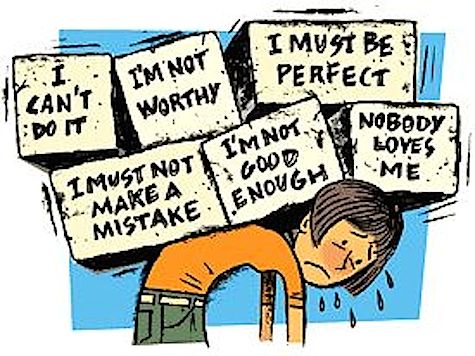
I woke this morning tired.  Mind you, I had only fallen asleep four hours before.  It’s a hazy morning, humid but tolerable with an intermittent breeze. I’m annoyed. Why? Because I’m tired, because it’s humid, because my mood took a slight dip while I wasn’t paying attention.  My first thought: I suck.

It’s not an uncommon thought for many, even if worded differently.  It’s the thought that rises when you believe that there is something you could do but haven’t, or that you have done but shouldn’t, etc.  In this moment, I suck because I’m tired and feeling lazy due to the humidity.   I suck  because my joints and muscles ache and I would prefer not to move.

Of course, the reality is that I do not suck.  Actually, I’m quite a lovely person, who tries her best at all times.  I just happen to have this type of response every now and again when it comes to dealing with my fibromyalgia.  It’s also a consequence of being perfectionistic.

So, how will I get myself out of this funk?  And how can you?  Well, I’m giving myself the proverbial reality check.  There are somethings that are within my control and beyond my control, including my body, my environment and the weather. What’s the point of beating myself up? There is none.

Putting myself down is a slippery slope that leads only to lowered self-esteem—and I’m not about that life.  The life that I’m about is one that lifts and heals the spirit, the body, and the mind.  I’m working on transforming that I suck statement into something more self-empowering, but first I have to confront with what’s really going on, take stock of my reality, and take action to improve my day.  I hope you will too! 🙂

In the meanwhile, check out this great personal article by analyst and professor Jane Boylton, Psy.D., M.F.T., “How Reality Checking Can Save Your Life & Your Dreams: You Can Easily Avoid One Sure Way to Suffer”  (PsychologyToday)


Until Tomorrow,

D.

Fibromyalgia & The Loudness of Absence: 3 Steps to Be More Present In Your Life

don_t-be-a-slave-to-writer_s-blockI think one of the scariest aspects of having fibromyalgia is the loss of control over the one thing that, if nothing else, you “should” have total control: your body.

It’s as though the bargain that you struck with your body once you left childhood suddenly becomes null and void. It’s like you left the car dealership and get home realizing you’ve been sold a lemon.  All right, maybe it’s not like that, but you get the idea. Something feels very unfair about all of this–and it’s true.

Fibromyalgia, like any illness, doesn’t do fair.  It doesn’t know how to play nice, and it’s quite selfish.  That’s the way it is.  Still, you have to live with it.  No matter how much it takes away from you. In fact, it can (and will) take so much away from you that you no longer know/understand who you are.

Fibromyalgia assumes and consumes your identity until you no longer exist.  I know. I’ve lived through it. I became absent in my life and from myself.  I allowed fibromyalgia to define me. Not. Any. More.

It’s easy to get bogged down in the misery of this illness: its randomness, its painfulness, its isolation, its depression.  The desire to withdraw from self and society can feel overwhelming, and I know many (including myself) who have retreated, in one way or another, from the world. Let’s stop that.  Let’s take back what is rightfully ours, Let’s reclaim our bodies and our minds!

It’s only a matter of taking it one step at a time.  So, today I’m sharing with you the 3 steps that I have taken and still take to be more present in my life.

  1. Remain Opento yourself and to possibilities that life has to offer.  Fibromyalgia changes you.  Be open to that change, rather than fear it.  There is a lot that having fibromyalgia will teach you about what it means to be alive.
  2.  Challenge Yourself Daily – Think fibromyalgia has made you into a sniveling, whiny, hell-hole of a person?  All right, well, that was yesterday.  Who do you want to be today?  Challenge yourself to be a better version who you were. Tomorrow is a whole other day, so focus on today, the here and now.
  3. Make Contact – No matter what, reach out to someone every day.  Call or meet a friend, check in with family, chat on an online support group or a social media network.  Reach out. Staying isolated with your illness is a sure path to further problems, psychologically and thus physically.  If you can, get outside and take a walk…even if it is for a few steps.  Taste the air outside, see the world around you, celebrate that life is happening and you’re a part of it.

I cannot promise you that taking only these 3 steps will change your life. They are, however, a good way to start doing so.  Remember there is a difference between the verbs to have and to be.

You have fibromyalgia. You are not fibromyalgia.

Let neither yourself nor anyone else define you by it.

Try every day, taking one step at a time along your path.

Until Tomorrow,

D.

Fibromyalgia & the Perfectionist: 3 Steps to Being a Perfectly Imperfect-Perfect You

Image from GIS

Image from GIS

The title is a tongue twister.  I dare you to say it fast 7 times. 

What happens when a perfectionist develops fibromyalgia? Well, I’ve spent the past 8 years learning the answer.

I don’t often speak or write about being a perfectionist. In fact, embracing imperfection, especially when it comes to body image and fibromyalgia, is often at the core of my blog posts, including this one.  The topic, however, has been on my mind over the past month as I transition from being a student to being gainfully employed. 😉

So, what have I learned over the past 8 years? Well, I won’t summarize it in this post.  One day , however, I’ll probably write a book about it…the subject feels that heavy.  For today, I wanted to share with you 3 steps that I’ve taken to being perfect at being imperfectly perfect.

3 Steps to Being a Perfectly Imperfect-Perfect You

  1. Chuck the Planner–Literally. Toss that thing in the trashcan…but do it perfectly.  Instead, invest in notepads and write anything you need to do for the next day/moment/whatever and stick the note somewhere you are likely to see it and, thus, remember, e.g. on your computer, mirror, refrigerator, front door, whatever. Just make sure you find the perfect spot for them.
  2. Downsize Your Goals–Thinking about hiking Mt. Everest tomorrow? Well, how about downsizing that to hiking your local trail today? What I mean is, focus your thoughts on doing what you can right now, in this very minute.  I know that my perfectionism has been both a great help and a massive hindrance to achieving goals.  Of course, I still have goals.  However, I have modified them by breaking them down (mentally) into smaller achievable steps.  Also…I now focus on enjoying the process instead of the product.
  3. Ignore Everyone–Meaning, ignore their opinions.  If there is one thing I know about being a perfectionist is that the opinion of others really mattered to me. I would choose to do something or not based upon how others would respond. Of course, this can be a good thing…but it can also be very detrimental, especially if you are creative–what is it that you haven’t painted, written, played, done etc. because you fear the response of others?   Well, right now, this very second, is the time to say enough is enough and pick up that paintbrush, pen, sheet music, etc. and do what you want to do.

Bonus Tip: Learn to listen to your thoughts, feel your feelings, heed your body, embrace your resilient spirit.  You won’t be perfect at first, and you will be judged (don’t worry…they’re not perfect either). However,  if you keep working on it, you will become a perfectly imperfect-perfect you.

Hey, this life is in this moment. How do you want to spend it?

Looking for more on letting go of perfectionism? Read this.

Until Tomorrow,

D.

FMS | The Necessity of Positive Self-Value

DSC001732Just a quick thought for today.

Remember that taking care of yourself, recognizing your strengths, working on your weakness, celebrating your small steps (and big ones) are necessary part of maintaining positive self-value.

It’s easy to get caught up in the what you can’t do or the  what you should do, instead of looking at what you have done and what you want to do.

Take a moment before the end of this day to check in with yourself.  Challenge yourself to acknowledging your positives, and then see how those positives can be extended to touch the lives those around you.

Until Tomorrow,

FMS | It’s TIme to Move In WIth Your Inner Child

Image  from "Kids Have No Prejudice" Documentary. Click to watch on YouTube

Image from “Kids Have No Prejudice” Documentary. Click to watch on YouTube

Fibromyalgia can suck the very joy of living out of you.  Seriously.  Sometimes you feel like there Is nothing to enjoy in life. And I  would say that it is an illness that can easily have a comorbid diagnosis of depression, which is only deepened by the somewhat unpredictable nature of the onset of symptoms, especially in the first couple of years when you are just beginning to learn about it.  In other words, fibromyalgia Is no walk in the park.

So, how can you deal with this lack of joy?  Well, I say the answer lies in beginning a conversation with your inner child.  Regardless of whether or not your inner child is healthy or hurting, they deserve to be expressed (especially if they are hurting).  Nurture your inner child.  Ask her or him what she or he would like to do today.  What simple pleasure would make your inner child smile?  Try answering that question, and see where it takes you.

Until Tomorrow,

D.